
Criminal Cases in the Tennessee Courts
Tennessee uses several court levels. General Sessions Court exists in every county. It handles warrants, preliminary felony hearings, and misdemeanor trials when the right to a jury and grand-jury review is waived. A supported felony moves from a preliminary hearing to the grand jury. A true bill creates an indictment. Circuit Court has general trial jurisdiction, while some busy judicial districts have a separate Criminal Court for felony trials and misdemeanor appeals. Municipal courts handle only the local matters the law assigns to them.
The elected clerk for the court keeps the Tennessee criminal case record. That file is procedural. It may contain the complaint, warrant, indictment, motions, hearing entries, judgment, and sentence. TBI’s TORIS history is different. TORIS is an identity-indexed state history built from submitted fingerprints and later disposition reports. It does not replace the clerk’s original court file, and the county file does not replace a multi-county TBI history. For court jurisdiction details, the Tennessee judiciary describes Circuit and Criminal Courts.
Tennessee Criminal Court Paths
A recent Tennessee arrest may generate records in more than one court. The affidavit of complaint or warrant commonly starts at General Sessions. Rule 5 calls for an appearance before an appropriate magistrate without needless delay, subject to the rule’s post-indictment exception. At a preliminary hearing, the judge tests probable cause. A supported felony is bound over. The grand jury may return a true bill or no true bill. An indictment then moves the matter to Circuit Court or a separate Criminal Court for arraignment, motions, plea, or trial.
Each step creates a distinct Tennessee court entry. A complaint is a sworn claim that starts a matter. An indictment is the grand jury’s formal charge. A disposition is the result for one charge. An acquittal, dismissal, guilty plea, diversion, and conviction are not interchangeable. Appeals from criminal judgments go to the Tennessee Court of Criminal Appeals, with further review in the Tennessee Supreme Court in the cases it accepts.
Note: A General Sessions entry may be only the first part of a Tennessee felony record that continues in another court.
How to Search Tennessee Court Records
Because Tennessee has no public statewide trial search, begin with the county and the level that handled the event. The AOC court clerk finder can be filtered by county, clerk type, and jurisdiction. Its official interface illustrates the statewide routing step.
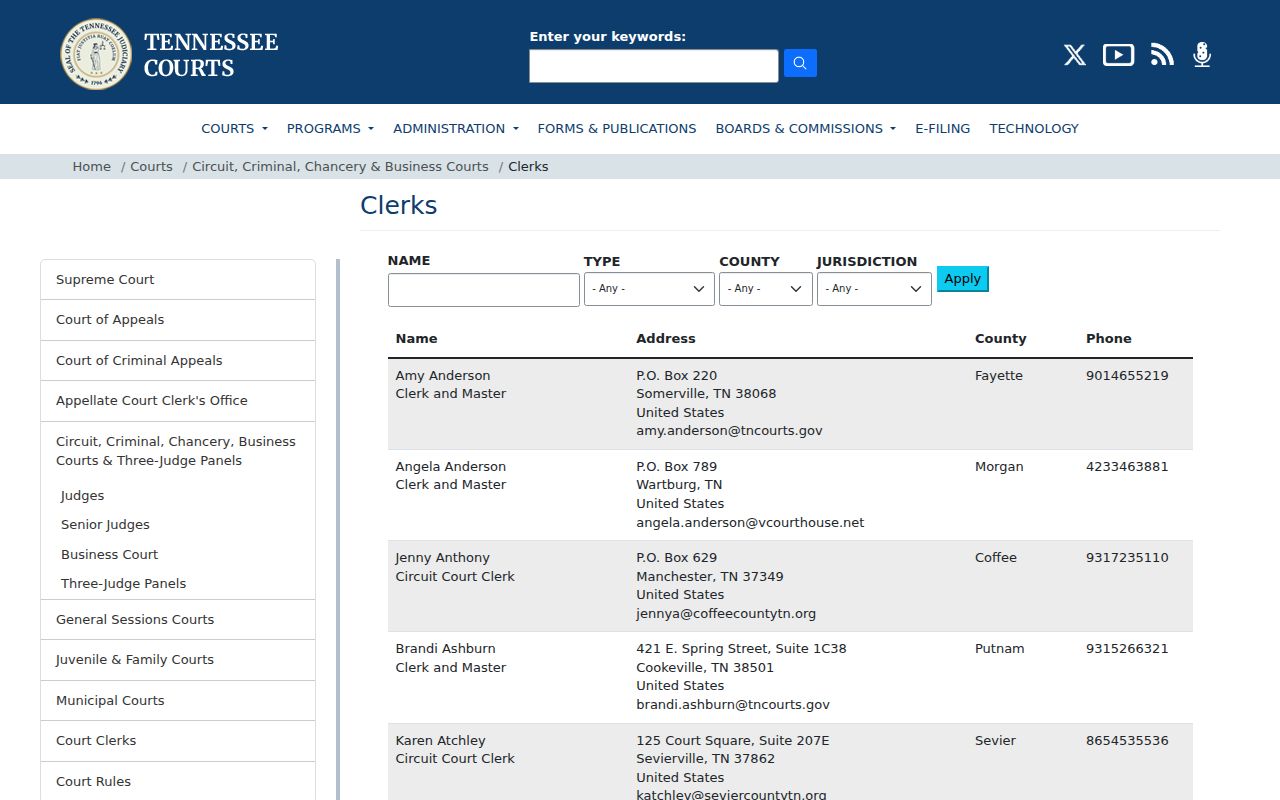
The directory points to the custodian. The clerk’s own portal, counter, mail process, or Tennessee Public Records Act procedure then controls access to the trial record.
- Identify the county and court. Use General Sessions for a recent warrant, misdemeanor, or preliminary felony matter; use Circuit or Criminal Court for an indictment or felony judgment.
- Open the AOC clerk finder. Select the county and the correct criminal jurisdiction, then follow the official clerk route.
- Search by the subject’s name or case number. Add a date range, birth year, charge, or case context if the county interface permits it.
- Read every count. Compare the original charge, amended charge, plea or verdict, disposition date, and sentence.
- Order a plain or certified copy from the clerk. Give the name, approximate year, and docket number for older material that is not online.
- Use C-Track only for an appeal. Check the county jail for current custody and TDOC FOIL for later state custody.
| Routing Field | Type | Required | Use |
|---|---|---|---|
| County | selection | Yes | Identifies the local record custodian |
| Clerk type | selection | Yes | Separates General Sessions, Circuit, and Criminal functions |
| Party name | text | Portal dependent | Search spelling often follows the arrest entry |
| Case number | text | Alternative | Best key when the exact docket number is known |
| Date or charge | filter | No | Helps distinguish similar names where offered |
Tennessee Appellate Case Search Limits
The AOC’s Public Case History is not a Tennessee trial-court search. It is the appellate C-Track system for Supreme Court, Court of Appeals, and Court of Criminal Appeals matters. Its published search keys include the appeal case-number sequence, all or part of the case style, a party’s first or last name, and an organization. Coverage begins with appeals whose records were filed after September 1, 2006. The data run through the prior business day.
The official C-Track Public Case History links motions, orders, judgments, and opinions filed after August 26, 2013, plus some older migrated orders.
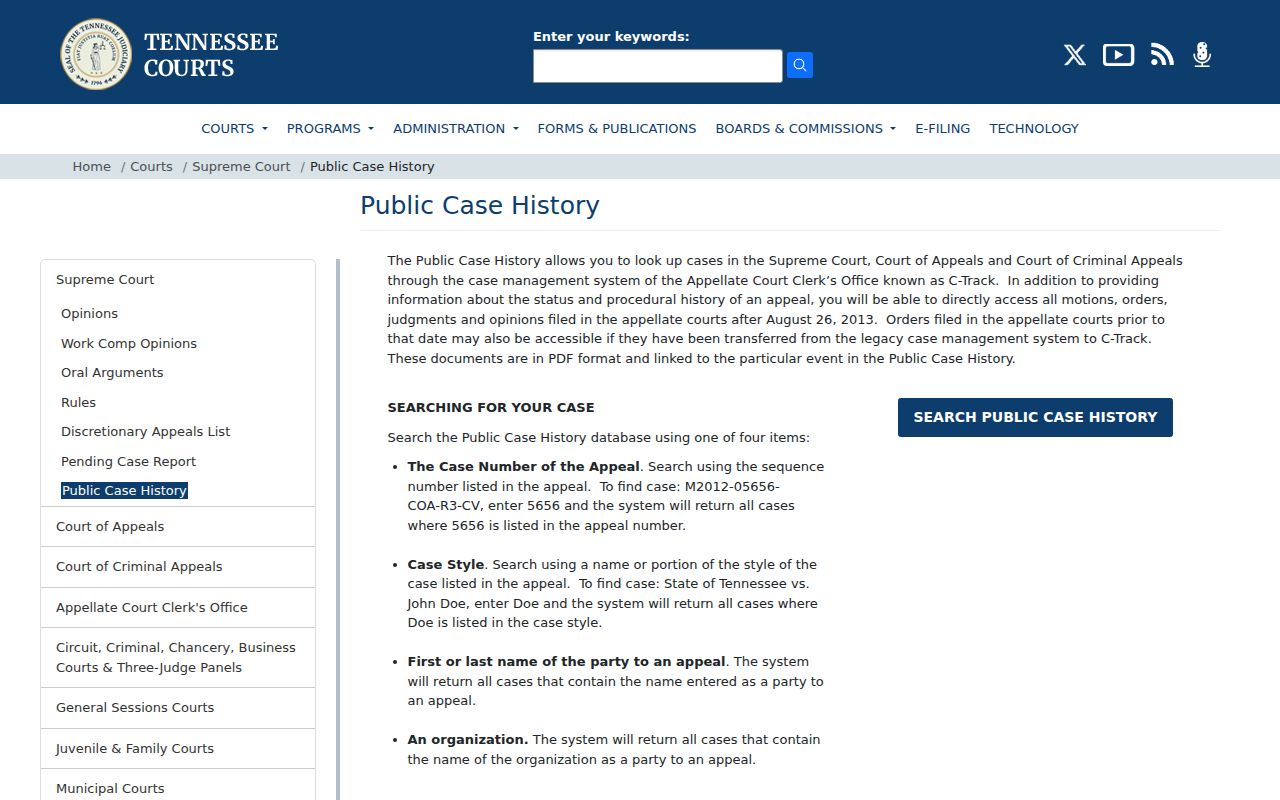
A result may list the appellate number, case style, appellate court, originating county, trial judge, filing date, status, events, document types, and PDF links. A missing appellate result says nothing about whether a trial case exists. Same-day and older appellate questions go to the Appellate Court Clerk.
What the Case File Shows
A Tennessee criminal court file follows one prosecution through its procedural life. Fields differ by court and portal, but the official TJIS reporting rules show the common core. They include location code, docket number, filing date, filing type, each charged count, the Tennessee Code section, offense class, amended charge, hearing type, count-level disposition, date, judge, and defendant identifiers. Social Security numbers are internal inputs and are not public fields to republish.
| Case Number & Court | Identifies the Tennessee docket, county, division, and court with custody of the file. |
|---|---|
| Charging Documents | May include the complaint, warrant, indictment, presentment, or information and each filed count. |
| Docket Entries | Chronological filings, settings, motions, orders, pleas, capias events, and appeal notices. |
| Hearing Dates | Past and scheduled appearances, subject to change by later Tennessee court orders. |
| Disposition | The separate outcome for each count, such as conviction, acquittal, dismissal, plea, or diversion. |
| Sentence & Judgment | The signed result may state confinement, probation, fines, restitution, and concurrent or consecutive terms. |
Reading Tennessee Case Outcomes
“Closed” is a case status, not a Tennessee criminal disposition. Read the outcome of each count. The official TJIS codes include acquittal; conviction; dismissal or nolle prosequi; guilty plea as charged; guilty plea to a lesser charge; transfer or remand; pretrial or judicial diversion; retired or unapprehended defendant; and other. One multi-count case can have several results. A charge may also be amended before the final result, so the filed offense and conviction offense may differ.
- Nolle prosequi
- The prosecutor formally declines to pursue a charge at that time. A qualifying nolle may be expunged without a fee.
- No true bill
- The Tennessee grand jury declined to indict on the proposed charge.
- Judicial diversion
- The court defers judgment while conditions are completed; qualifying completion may lead to expungement.
- Disposition
- The court’s specific outcome for a charge, not merely the overall case status.
Public access has limits. Tennessee Supreme Court Rule 34 recognizes access but protects sealed material, confidential categories, judicial drafts, deliberative work, and information covered by statute or court order.
Stages of a Tennessee Criminal Case
The first public Tennessee record may be an affidavit, warrant, citation, or booking entry. General Sessions supplies the first hearing and, in a felony, the probable-cause step. A true bill moves the charge to Circuit or Criminal Court. Arraignment records the plea. Pretrial motions produce docket entries and orders. A plea or trial yields count-level outcomes. The judgment states the sentence. An appeal creates a separate appellate docket rather than replacing the county trial file.
Case flow: Charges Filed › Arraignment › Pretrial › Plea or Trial › Disposition › Sentencing
A capias may list the case number, court, county, charge, bond, issue date, clerk, and return of service. Active or sealed process may not appear in a public search. A current Tennessee arrest history should be checked against the later court judgment because a booking charge can be rejected, changed, dismissed, or followed by an acquittal.
Note: Expunged Tennessee charges should not be treated as missing data when a lawful court order removed them from public access.
Tennessee County Portal Differences
Tennessee trial access varies even among large county systems. Davidson County’s official open search offers person, case-number, and complaint or incident modes. Person mode requires at least two letters of the first name and one character of the last name; date of birth is optional. The portal says expunged charges are omitted and warns that birth dates may be absent. Its legacy coverage begins in 1980, with later CJIS transition dates for General Sessions and state trial dispositions.
The Davidson criminal search shows one open-access pattern.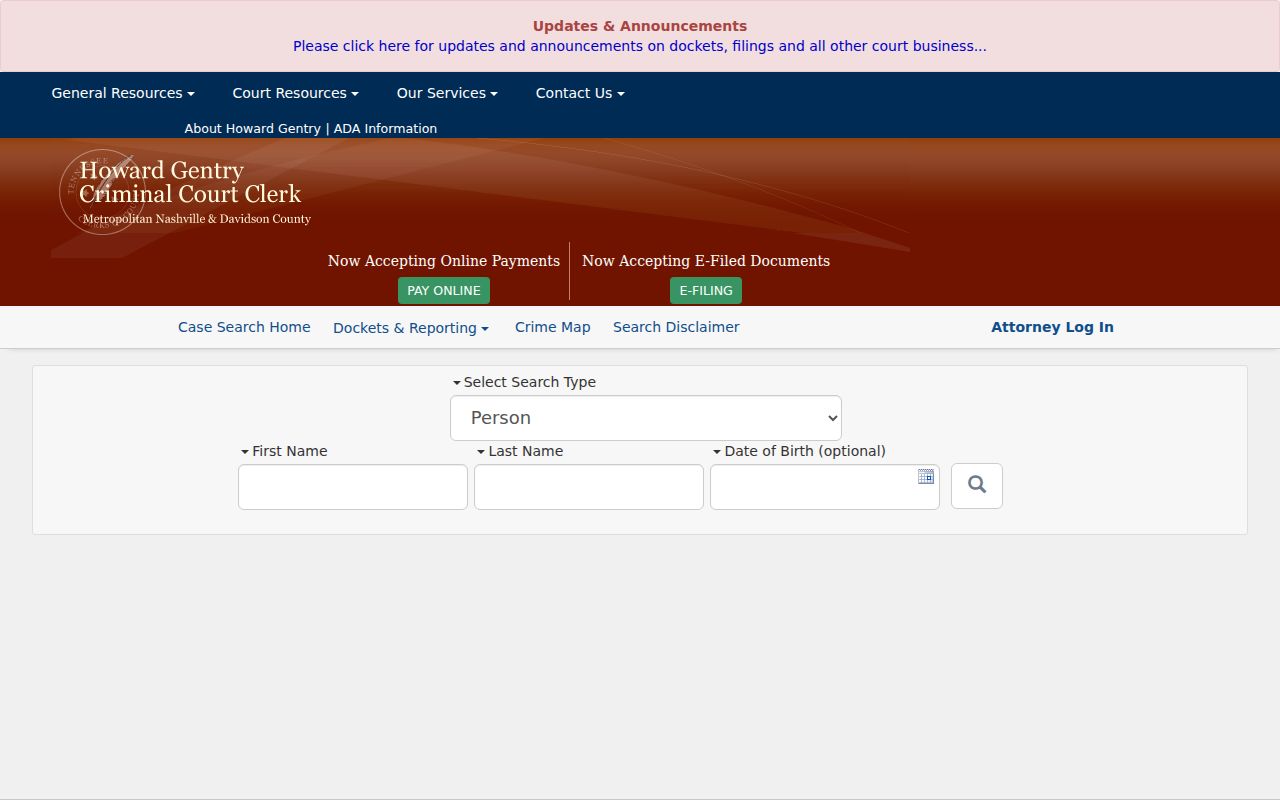
Its visible search modes show how a Tennessee county can expose several keys without creating statewide coverage.
Shelby County uses another path. Its current CJS Smart Search requires registration and sign-in. Number formats also changed over time, including an Odyssey format beginning with C, a two-digit year, and a five-digit sequence. The Shelby Criminal Court access page documents that gated model.
These examples show why one county’s fields, fees, and date coverage cannot be applied to all Tennessee criminal records.
Finding Case Records by County
The full Tennessee trial file stays with the clerk where the case was filed. Online summaries may omit document images, financial details, old files, and protected material. Ask that clerk for the docket, judgment, or certified copy. For an archived record, give the defendant name, approximate year, court level, and docket number. A request under the Tennessee Public Records Act should describe an existing record, not ask the clerk to conduct research or create a new report.
Inspection is generally free. Copy and labor charges may apply under the custodian’s policy. If the record is not promptly available, a Tennessee custodian must generally produce it, deny it in writing with a legal basis, or provide a time estimate within seven business days. County trial fees are separate from appellate charges.
Browse the full directory of all 95 Tennessee counties to reach the correct local criminal records site. That county route is also the best fallback when a name search lacks a birth date, a portal stops before the case year, or a certified judgment is needed. Verify identity with several matching facts. A shared name alone is not enough.
Older Tennessee Criminal Case Records
An absent online result does not prove that no Tennessee case exists. County digitization dates differ. Older dockets may remain on paper, microfilm, or a legacy system. Start with the correct clerk and give a narrow year range. Ask whether the court has a retired docket index and whether the file can be inspected, copied, or certified. If a case was appealed, search C-Track as a separate step. The appeal may reveal the trial county, judge, judgment date, procedural history, and linked opinion without supplying every trial filing.
Three records can answer three different questions. A portal summary is useful for quick docket context. A certified judgment is the strongest county source for the final count-level result. TORIS compiles fingerprint-founded Tennessee history received by TBI. If they conflict, begin with the originating clerk, then use the certified record to address an incorrect repository entry through the TBI correction process. Keep any certified expungement order. It may be needed if an eligible record still appears in a county, TBI, or corrections system after processing.
Note: A certified Tennessee judgment carries more detail and authority than a portal summary when the final result must be verified.