
How to Check Criminal History in Tennessee
Start with the question, not a person-search box. TBI's Tennessee Open Records Information Services, or TORIS, is the consistent statewide name check for fingerprint-founded misdemeanor and felony arrest events submitted to TBI. A county clerk holds filed charges, docket events, judgments, and copies. A sheriff or jail is the better source for a fresh booking. TDOC's FOIL serves felony custody and supervision, while TBI's registry has its own public search. Each system answers a different question.
Accurate names, a date of birth, the likely county, and an approximate event date help narrow a Tennessee criminal record search. Name matches still require care. A possible TORIS result is not a fingerprint confirmation, and a booking charge is not a conviction.
- Choose TORIS for statewide repository history or the matching subject system for a case, booking, custody, or registry question.
- Enter known identifiers exactly and read the portal's scope before paying or relying on a match.
- Use the county directory for the clerk, sheriff, jail, or arresting agency that created the original Tennessee record.
- Compare the charge, date, county, and final disposition across sources instead of treating one result as complete.
- For an error on your own TORIS report, use TBI's fingerprint comparison and correct the source judgment with the county clerk.
Tennessee Criminal Records Move in Stages
A Tennessee arrest starts locally. The arresting agency creates the report. The jail makes a booking record and captures fingerprints. TBI says its criminal history is based solely on misdemeanor and felony arrest fingerprints submitted by arresting agencies. After court action, clerks can send dispositions, diversions, and expungements through FlexCheck. Public Chapter 554 requires covered clerks to notify TBI electronically within three business days of a final disposition.
Record flow: Arrest › Booking › Fingerprint submission › County case › Disposition › TBI repository update.
This chain explains gaps. The county docket can show a newer judgment before it links to the arrest cycle. A jail roster may show custody before charges are filed. TBI's dated 2022 benchmark found that about 55% of repository records then had a final disposition linked to an arrest. That figure is historical, but it shows why source checks still matter.
The Tennessee Criminal History Repository
The Tennessee Bureau of Investigation Criminal Justice Information Services Division runs the central repository. Its public TORIS product permits a Tennessee name-based open-records check. The result is based on submitted arrest fingerprints, yet the search itself does not verify identity by fingerprint. Online results exclude aliases and most juvenile information. A youth transferred for adult prosecution under state law is the limited juvenile exception described by TBI.
A fingerprint-based TAPS check is different. Tennessee Applicant Processing Services uses IdentoGO for checks authorized by a state program, and results go to that requesting program. It is not a freely chosen public search. People reviewing their own nationwide FBI history may instead use the FBI subject-only process. Each channel has its own scope and correction path.
When Tennessee TORIS Finds a Match
The official TORIS landing page states the Tennessee-only scope, nonrefundable $29 price, credit-card route, and billable-account login. Its interface is shown below. The online path begins with requester contact details. Accurate subject information is then crucial because the query is name based.
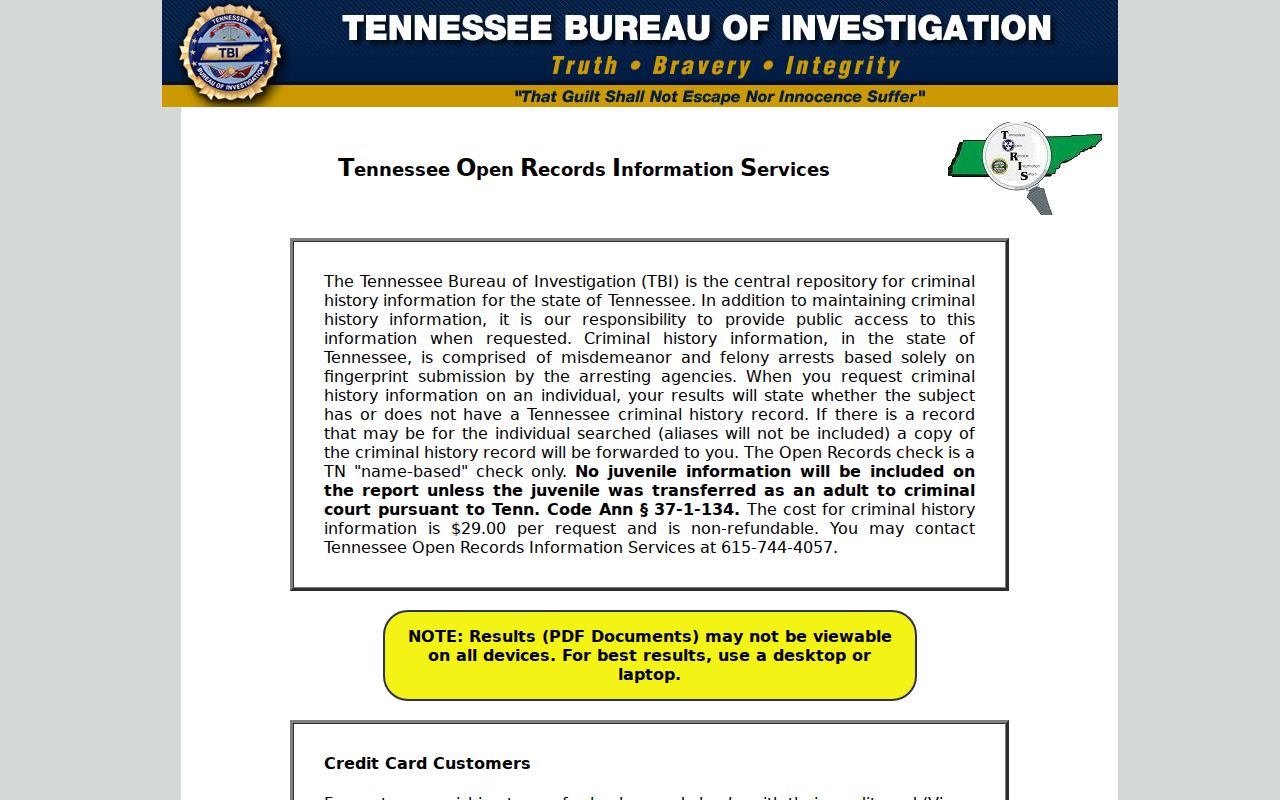
The screen makes two limits easy to miss: TORIS is not a nationwide history and it does not confirm identity by fingerprints. Save the PDF on a desktop or laptop if a phone cannot display it. Then compare any listed arrest, charge, and disposition with the originating county clerk. For a disputed personal result, local law-enforcement fingerprints, a dispute letter, and TBI's $24 comparison process provide the official identity check.
| Requester field | Type | Required | Use |
|---|---|---|---|
| First and last name | Text | Yes | Identifies the requester |
| Street, city, state, ZIP | Text and list | Yes | Contact and billing details |
| Phone | Text | Yes | Requester contact |
| Email and confirmation | Yes | Transaction confirmation | |
| Account credentials | Login | Account route only | Billable users |
Statewide Record Systems in Tennessee
Tennessee has useful statewide systems, but no public trial-court name search spanning all 95 counties. C-Track covers appellate matters filed after September 1, 2006. County clerks remain the source for trial cases. TORIS, FOIL, the Tennessee Sex Offender Registry, and CrimeInsight cover other parts of the system. Restricted TIES and TCIC law-enforcement data are not public warrant or rap-sheet portals.
| System | What It Holds | Run By |
|---|---|---|
| Tennessee Open Records Information Services | Submitted fingerprint-founded Tennessee arrest history | TBI CJIS |
| Felony Offender Information Lookup | Felony custody and TDOC supervision profiles | Tennessee Department of Correction |
| Tennessee Sex Offender Registry | Public adult registry profiles, maps, and alerts | TBI |
| C-Track Public Case History | Covered Tennessee appellate cases and documents | Tennessee appellate courts |
| CrimeInsight | Aggregate TIBRS crime and arrest statistics | TBI |
Use a county source when the question concerns an original booking, incident report, trial docket, judgment, or local warrant. State summaries do not replace those files.
Tennessee Criminal Custody Has Three Layers
County jails, TDOC prisons, and federal custody are separate. A county jail can hold a person awaiting trial, serving a local term, or waiting for transfer. FOIL covers people who are or have been in TDOC felony custody or supervision. The federal Bureau of Prisons locator covers federal sentences. A person may also remain physically in a local jail after a state sentence, so portal status and physical location can differ.
TDOC publishes annual reports and statistical abstracts that define those populations. The report library pictured below gives year-specific counts rather than a live person lookup.
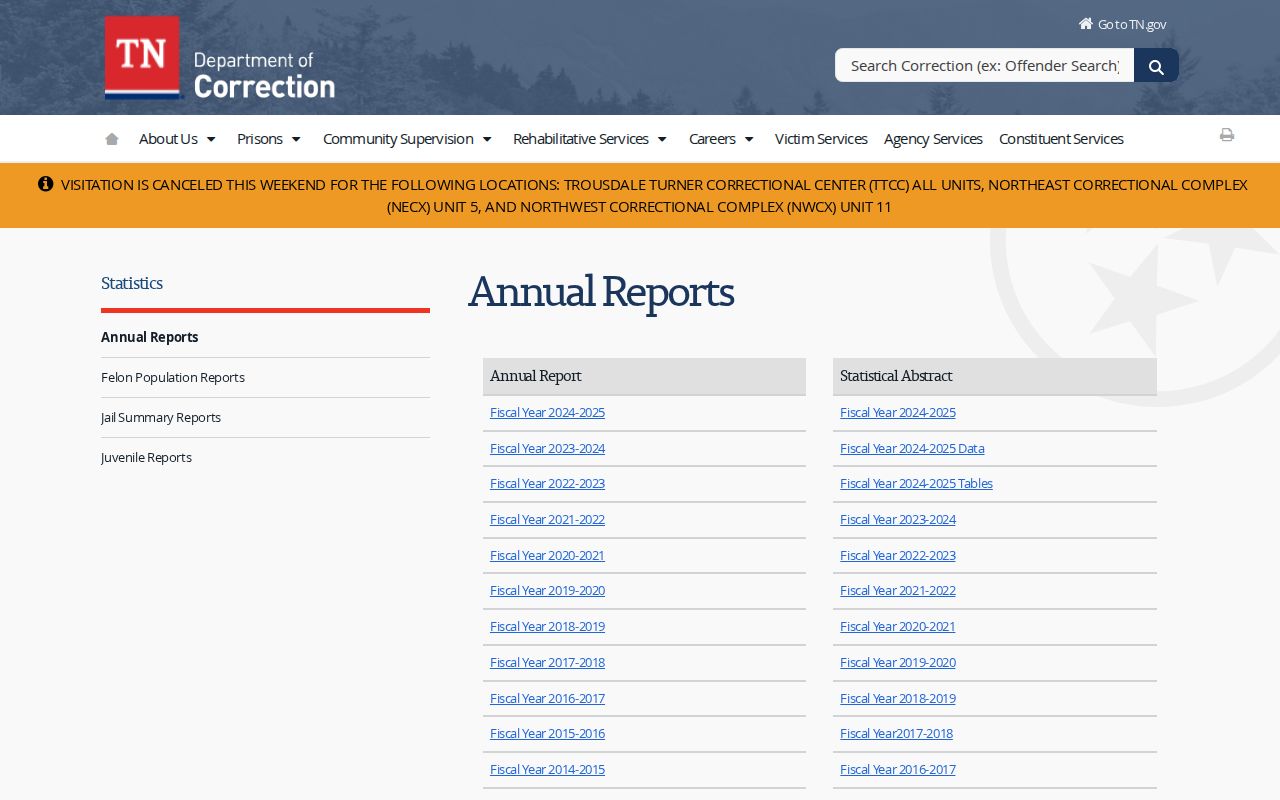
The current official prison roster lists 14 prisons. FY2025 reported an average monthly institutional population of 19,651, while the June 30, 2025 snapshot counted 20,075 in the TDOC population and 9,049 state felons in local jails. Always keep the date and definition with a corrections number. Tennessee VINE can add free custody-change notices, but the source agency should confirm any status.
Types of Criminal Records
One Tennessee event can create several records. They differ by custodian and legal meaning. The arresting agency's report describes the response. A jail record documents intake and custody. A court file tracks prosecution and judgment. TBI compiles submitted arrest cycles and reported outcomes. Supervision and registry entries are separate again.
- Arrest record
- An agency and booking record of custody based on an allegation, not a finding of guilt.
- Case file
- The clerk's docket, charges, filings, hearings, judgment, and sentence for one prosecution.
- Rap sheet
- A compiled repository history organized around fingerprint-founded arrest cycles and later disposition reports.
- Disposition
- The outcome of a charge, such as dismissal, guilty judgment, acquittal, or nolle prosequi.
- Supervision record
- TDOC or Board information about probation, parole, status, and assigned oversight.
The safest reading compares a Tennessee criminal court case file with the matching repository event. Neither record replaces the other.
Tennessee Criminal Charge Classes
Tennessee labels felonies from Class A through Class E and misdemeanors from Class A through Class C. The label helps identify the statutory range, but it does not tell a reader what happened in the case. A booking class is still an allegation. The final charge, count-level disposition, and sentence come from the court judgment. Offense-specific laws can also set different fines, and sentencing depends on more than the class alone.
- Class A felonies carry the highest general range, 15 to 60 years, with a general maximum fine of $50,000.
- Class B through E felonies step down through statutory ranges, ending with one to six years and a general $3,000 maximum for Class E.
- Class A misdemeanors permit up to 11 months and 29 days, while Classes B and C have shorter general maximum terms.
- Court level matters: General Sessions handles preliminary felony work and some misdemeanor trials, while felony trials proceed in Circuit or a separate Criminal Court.
T.C.A. §40-35-111 supplies the general penalty ladder. It should not be used to predict a sentence from a portal label. Prior record, offender range, release eligibility, offense-specific rules, and concurrent or consecutive findings may change the result. Expungement eligibility also comes from the specific list in T.C.A. §40-32-101, not from a simple assumption that every lower-class conviction qualifies.
Tennessee Warrants and Supervision Records
Tennessee has no public statewide warrant index. TIES, TCIC, and NCIC are restricted law-enforcement networks. Public checks therefore start with the likely county sheriff and court. General Sessions often handles arrest warrants and early felony proceedings. Circuit or a separate Criminal Court holds post-indictment events, and a municipal clerk may hold a warrant tied to its limited jurisdiction. Published lists can be partial or delayed. The issuing court controls recall and bond, so a Tennessee-licensed lawyer or that court should guide resolution.
Felony probation and parole supervision are statewide through TDOC Community Supervision. Courts order probation. The Tennessee Board of Parole makes discretionary parole decisions, while TDOC supervises release. FOIL may show current supervision, but the county judgment states the sentence. TDOC's county-keyed field-office directory identifies the office serving each location. Local misdemeanor arrangements can vary with the sentencing court.
Note: A missed report or stale portal entry does not prove that a Tennessee violation warrant exists.
Tennessee Police and Crash Records
There is no state pool for every local police report. Request an incident or arrest report from the agency whose officer made it, using that agency's records channel or a Tennessee Public Records Act request. Tennessee Highway Patrol crash reports have a distinct process. The official THP crash-report instructions show online, mail, and district-office options.
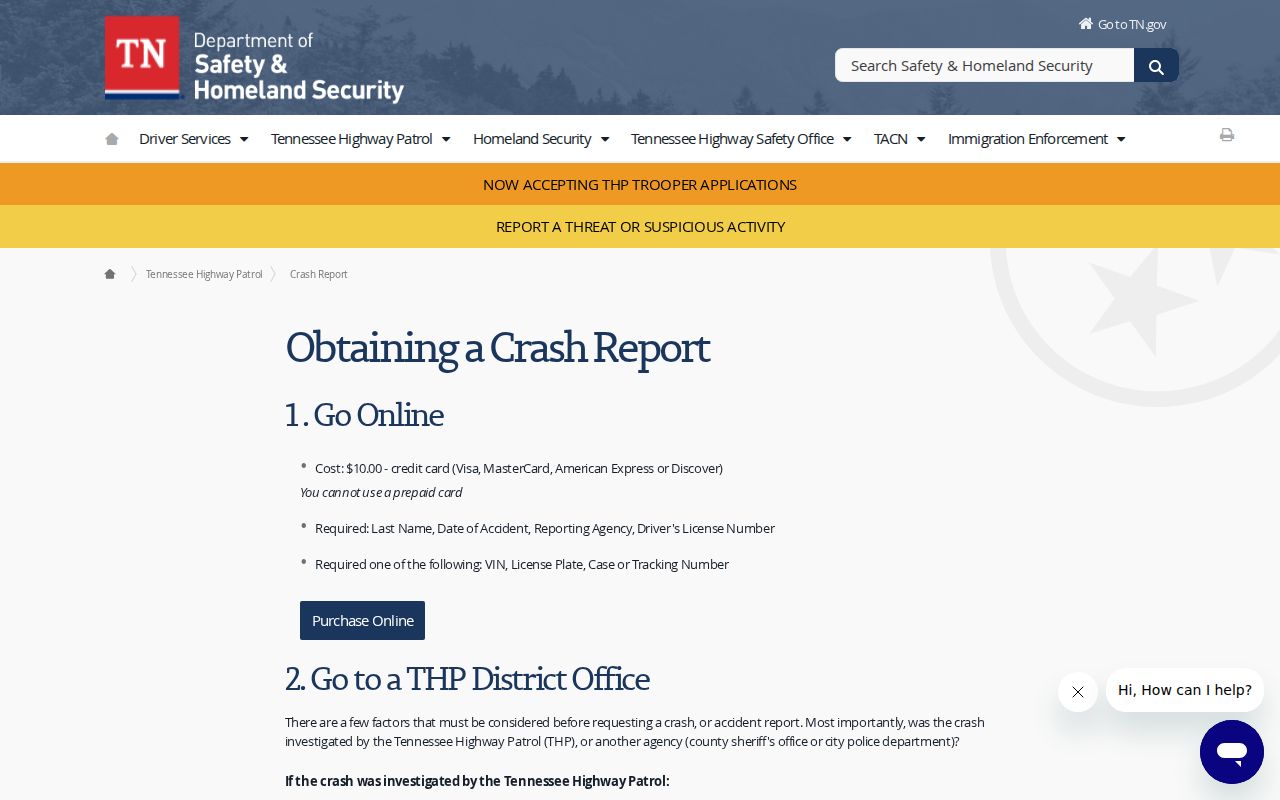
An online crash report costs $10, while an eligible district-counter or mail request is $4. A local agency remains the source when it investigated the crash. The official demo safely illustrates the purchase fields without exposing a real person's data.
The Purchase TN Crash demonstration asks for a last name, accident date, reporting agency, driver-license number, and another locator such as a vehicle, case, or tracking number.
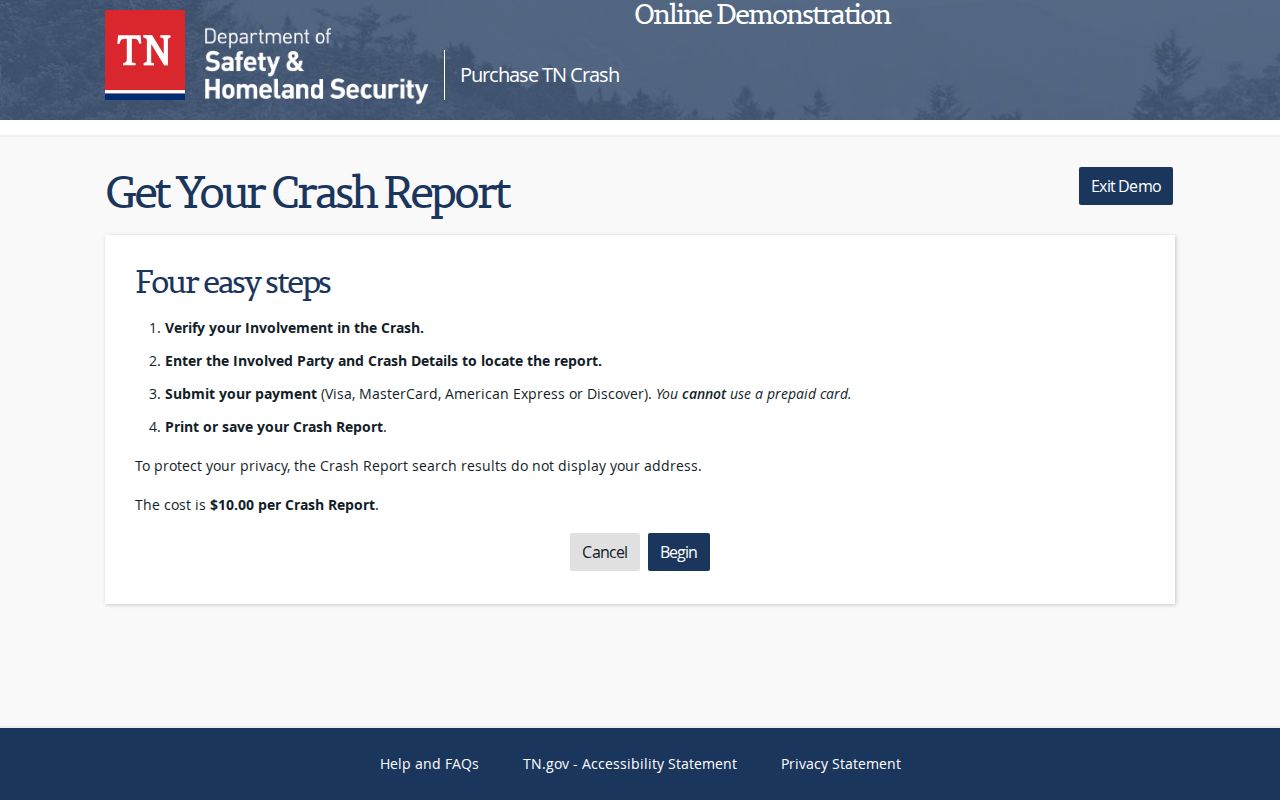
Those fields belong to crash ordering, not a general criminal history check. Body-camera footage, 911 data, victim information, and active investigative material may require redaction or fall within a specific exception. Ask for the written legal basis if a custodian withholds a requested Tennessee record.
Public Access Laws
The Tennessee Public Records Act gives Tennessee citizens access to existing state, county, and municipal records, subject to specific exceptions. A request goes to the custodian that made or holds the record. Inspection is generally free. Copy requests may be required in writing and can carry reasonable copy and production costs. If a record is not promptly available, the custodian has seven business days to produce it, deny it in writing, or provide a written estimate of more time.
Key Tennessee authorities:
T.C.A. §10-7-503 establishes the public-record request framework and custodian route.
T.C.A. §10-7-504 and Supreme Court Rule 34 preserve confidential categories, sealing orders, and court-specific protections.
Title 38, Chapter 6 supports TBI's repository role while restricted CJIS networks remain limited to authorized users.
T.C.A. §40-32-101 controls eligible expungement relief through the originating Tennessee court.
A public record can still contain redactions. Juvenile files, grand-jury material, protected victim data, sealed filings, and specified investigative records are not ordinary open records.
Tennessee Criminal Record Expungement
Expungement begins where the case began. The originating General Sessions, Circuit, or Criminal Court supplies the docket and charge details and processes the petition or qualifying no-cost request. Dismissed charges, no true bill, release without charge, not-guilty verdicts, and certain nolle prosequi outcomes are among the no-fee categories summarized by the judiciary. Conviction relief is narrower and statute specific. A March 2026 banner said updated information was coming after changes to T.C.A. §40-32-101, so current eligibility and fees must be checked before filing.
The Tennessee judiciary's expungement page shows the originating-court workflow and current update notice.
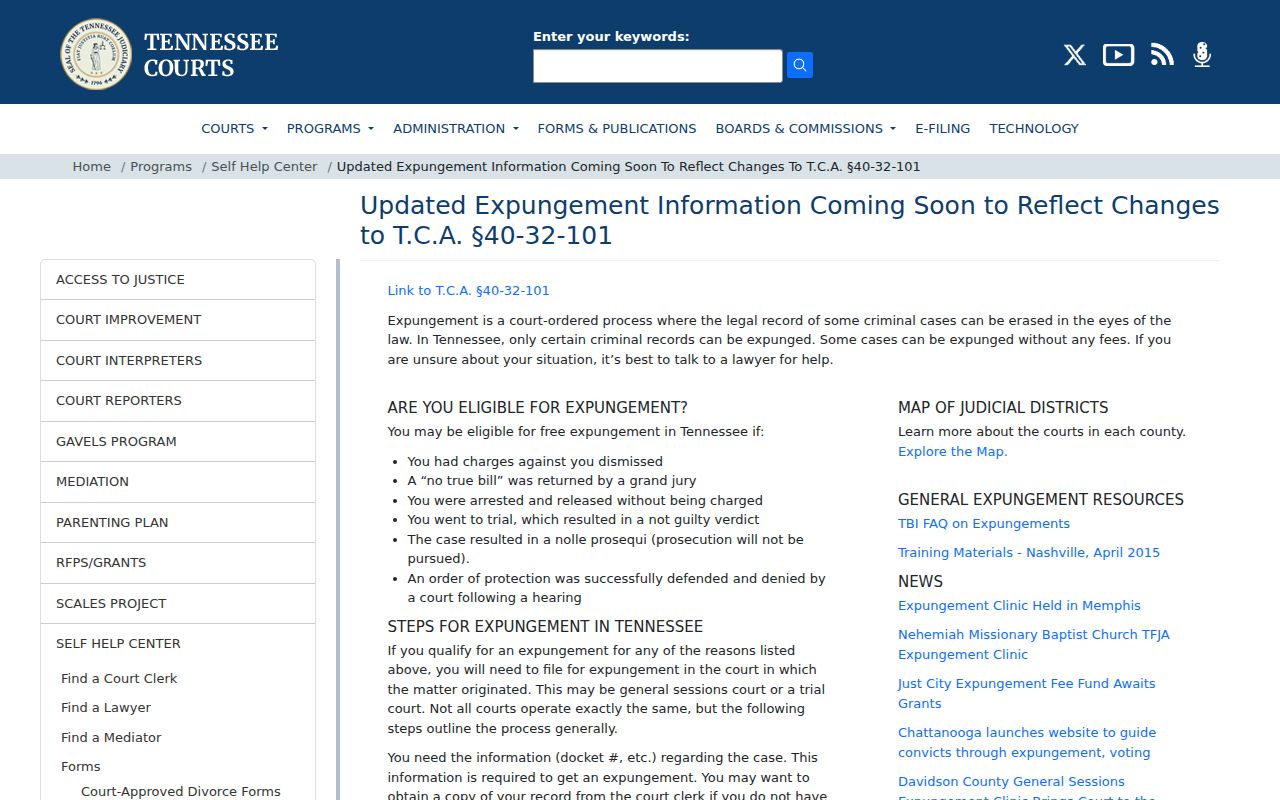
Keep certified copies of the signed order and charging document. The clerk distributes an order to the arresting agency, jail, TDOC, TBI, and other recipients. TBI then removes the qualifying charge and sends the order to the FBI. After processing, check the county file, your own TORIS report, and FOIL when relevant.
Tennessee Criminal Record Fees
State product fees are not county copy fees. TORIS charges per name search. TBI's comparison fee applies when someone disputes a returned TORIS record and submits fingerprints. TAPS prices depend on the authorized service code. County clerks and agencies can set lawful copy, certification, postage, media, and labor charges, so their current schedules control local requests.
| Official item | Amount | Important limit |
|---|---|---|
| TORIS name check | $29 | Nonrefundable Tennessee name search |
| TORIS fingerprint comparison | $24 | Local fingerprint fee may be extra |
| FBI-only self-review through TBI contractor | $50 | Fingerprints required |
| TPRA inspection | Normally $0 | Copies and labor may cost |
| Standard copy guideline | 15¢ black and white; 50¢ color | Labor after the first hour may apply |
Note: Confirm every Tennessee fee at the official order page or record custodian before submitting payment.
Federal Records Outside Tennessee Systems
Tennessee repositories do not hold every federal case or federal sentence. PACER is the official federal court system for the Eastern, Middle, and Western Districts of Tennessee. The federal Bureau of Prisons locator covers federal inmates, generally from 1982 forward, and updates daily. Neither result belongs to TORIS or a county clerk's Tennessee trial docket.
For a personal nationwide history, the FBI Identity History Summary requires fingerprints and is available only to the subject. The direct FBI fee was $18 in the inspected official material. An FBI correction uses the federal challenge process, while a wrong Tennessee judgment must also be corrected with the originating agency or court. A clear result from one system does not prove that all other systems are empty.
Find Criminal Records by County in Tennessee
Arrests, bookings, trial cases, incident reports, and local warrants are created in Tennessee counties. The eight featured counties below illustrate why the local route matters: court clerks and sheriff custody systems are distinct from TORIS and FOIL. Every county in Tennessee has a dedicated local records site.
Shelby County
Memphis · Largest population and separate criminal court, sessions, and jail channels
Davidson County
Nashville · Capital metro with distinct court and sheriff systems
Knox County
Knoxville · East Tennessee court, detention, and federal record routes
Hamilton County
Chattanooga · Major southeast court and custody hub
Rutherford County
Murfreesboro · Fast-growing metro with separate docket and custody searches
Williamson County
Franklin · Local clerk and sheriff records supplement state checks
Montgomery County
Clarksville · Multiple law-enforcement and court sources
Sumner County
Gallatin · Sessions, Circuit, and jail channels hold different records
Browse the full directory of all 95 Tennessee counties to open the criminal records site for any county.